Notes·the loop
Barrels Move the Lanes, Not the Loop
A lane shift moves where you drive, not where 270 is. As barrel season ends, here is why the in270 mark, traced from OpenStreetMap, never gets a detour drawn in.
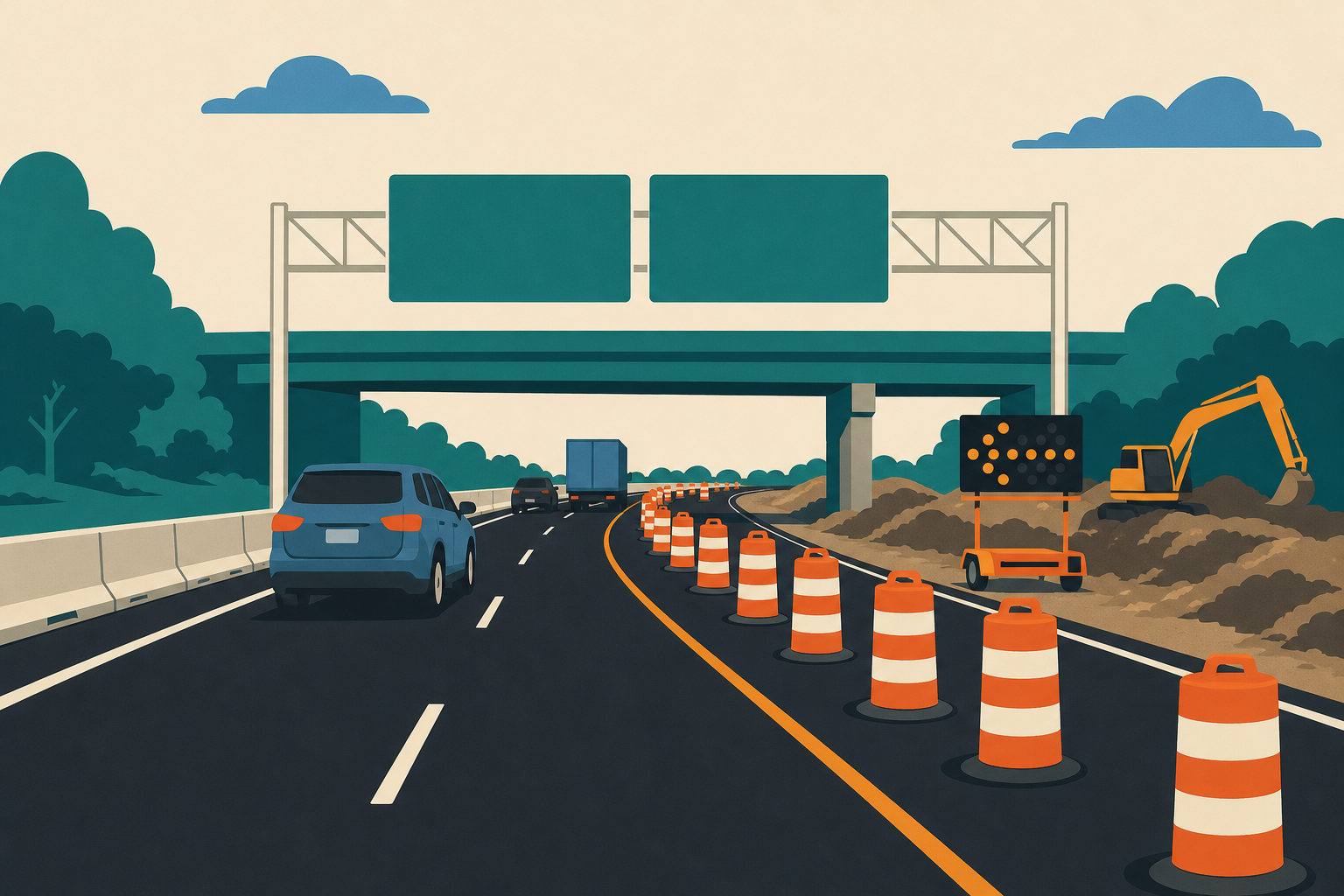
A lane shift changes where you drive. It does not change where 270 is. The in270 mark is the I-270 outerbelt as mapped by OpenStreetMap contributors under the Open Database License, so the east bulge toward the airport, the flat north side and the Grove City hook stay exactly where they were in April, no matter how many orange barrels lined the shoulder between then and now. The pavement moved a lane or two this summer. The shape on your bumper did not move at all.
That is the short answer. Here is the longer one, for anyone who spent barrel season reading cones instead of signs.
Does road construction change the shape of 270?
No. Construction moves traffic around the road. It does not move the road. A temporary crossover can push you onto the other side of the median for a stretch, and a ramp can slide over a lane so the gore point shows up later than your muscle memory expects. None of that redraws the loop.
The outerbelt still wraps the same ground. It still swings east past the airport, still runs flatter across the north side from Worthington over toward Westerville, still hooks around Grove City on the southwest. If you want the long version of that bend, there is a whole post on the Grove City hook.
What barrel season actually looks like from the driver's seat
If you drive 270 between spring and the end of October, you already know this part. For newcomers, here is what to expect, described the way a driver sees it, not the way a project sheet would.
Crossovers and lane shifts
The lane lines get painted over and repainted somewhere else. Sometimes the old stripes still ghost through in the rain, which is fun. You follow the barrels, not the faded paint.
Ramps that wander
An exit you take every day opens a little early or a little late. The ramp is the same ramp. It just starts somewhere new for a few months.
The usual spots get more usual
The Easton weave, already tight on a normal day, gets tighter when a lane is coned off. The Sawmill backup, already long, gets longer. Nobody needed a barrel to make either of those worse, but the barrels helped.
We are not going to list specific closures here. They change, and a post that names last month's ramp closure is a post that is wrong by next month. Check ODOT for that.
Why the in270 mark never gets a detour
The line on your dashboard bends for a few months. The line on your bumper does not. That is on purpose.
The in270 kit, the site and the license all say the same thing: you can recolor the mark and you can scale it. You cannot smooth it, symmetrize it or reproject it. Nobody gets to draw in a detour, the same way nobody gets to round the loop off into a circle because a circle looks neater on a slide.
The reason is simple. The mark is traced, not designed. The path data comes straight from OpenStreetMap. The east bulge is on the map. The Grove City hook is on the map. If we started nudging the geometry to match a summer of lane shifts, or to make it prettier, it would stop being the road. It would just be a logo shaped like a road. There is more on that in why the mark looks hand-drawn.
So every copy is the same road. The sticker on a Clintonville garage door, the one on a laptop in a Short North coffee shop, the cling in a shop window off Morse: same geometry, every time.
The barrels are temporary. So is your patience.
The barrels are the one thing on 270 more temporary than your patience. The mark is the one thing on 270 less flexible than ODOT.
Barrel season runs April through October, and we are in its last days. Some of the cones are already stacked on the shoulder waiting for a truck. Lanes are going back to where the paint says they are. The road settles back into the shape it always had, which, conveniently, is the shape you already stuck on your car.
What comes next is not barrels. It is salt. If your sticker made it through a summer of sun and lane shifts, winter is the real test. We wrote up what road salt does to a loop sticker and what to do about it before the first brine truck rolls.
Reading 270 and the roads inside it, once the cones are gone
For newcomers, barrel season is a rough way to learn the outerbelt. Here is the plain version, minus the cones.
270 is the loop. Inside it, 71 runs through the split downtown and straight north. 70 runs across, east to west. 670 and 315 follow the rivers. All four are in the mark, inside the loop, the way they sit on the map.
Most people inside 270 do not say a neighborhood name first. They say an exit. Dublin. Easton. Polaris. If that sounds odd, read what inside 270 really means. And if you have been arguing with someone about which exit is really yours, the answer might be the one that runs your commute, not the one closest to your house.
Your stretch, a fresh sticker, a cling for the window
The loop has thirteen stretches, from Dublin around to Linworth and back. Each one has its own page with the mark lit up in brick for that section and a version you can download and share. Your stretch did not change shape this summer either.
If your old sticker took a beating from a season of construction dust, grab a fresh file from the kit. Personal use is free. Local independent businesses inside the loop use it free too, and if you run a shop with a street-facing window, we will bring you a free window cling.
The barrels come down. The shape stays the one people chose. Find your stretch of 270 and download your exit's version of the mark, or request the free window cling at https://in270.com and we will bring it by.
Questions people ask
- When does barrel season end in Columbus?
- Barrel season on the loop generally runs April through October. By the end of October the orange barrels start coming down, lanes go back to where the paint says they are, and the next thing to worry about is winter salt. Specific projects run on their own schedules, so check ODOT for any particular closure rather than assuming every cone disappears at once.
- Can I change the shape of the in270 logo?
- No. You can recolor the mark and scale it, and that is it. The kit, the site and the license all forbid smoothing, symmetrizing or reprojecting the geometry. The mark is the I-270 loop traced from OpenStreetMap under the Open Database License, so altering the shape would make it stop being the actual road. No detours, no circles.
- Where is the Easton weave on 270?
- The Easton weave is on the northeast side of the loop near Easton, where traffic entering and exiting crosses paths in a short stretch. It is tight on a normal day and tighter when construction cones take a lane. The Easton stretch has its own page on in270.com with the mark lit up for that section of the loop.
barrel-season · i-270 · openstreetmap · easton-weave · lane-shifts
Drawn from the map. Map data from OpenStreetMap contributors. Open Database License.